
Best Tai Chi Exercises for Beginners
A Simple Guide to Building Balance, Strength, and Inner Calm
Tai chi is one of the easiest ways to improve your physical and mental well-being. Often described as “meditation in motion,” it combines slow, controlled movements with deep breathing and mindful focus. Unlike high-impact workouts, tai chi is gentle on the joints, making it suitable for people of all ages and fitness levels.
If you’re just starting, learning a few foundational movements is the best way to build confidence while improving balance, flexibility, posture, and relaxation. This guide explores the best tai chi exercises for beginners and explains how to practice them safely and effectively.
Why Beginners Should Practice Tai Chi
Tai chi offers a wide range of benefits without requiring expensive equipment or previous experience. Regular practice can help:
- Improve balance and coordination
- Increase flexibility and joint mobility
- Reduce stress and anxiety
- Strengthen the legs and core
- Improve posture and body awareness
- Enhance focus and concentration
- Support healthy aging
- Promote better breathing habits
Even practicing for just 15 to 20 minutes a day can make a noticeable difference over time.
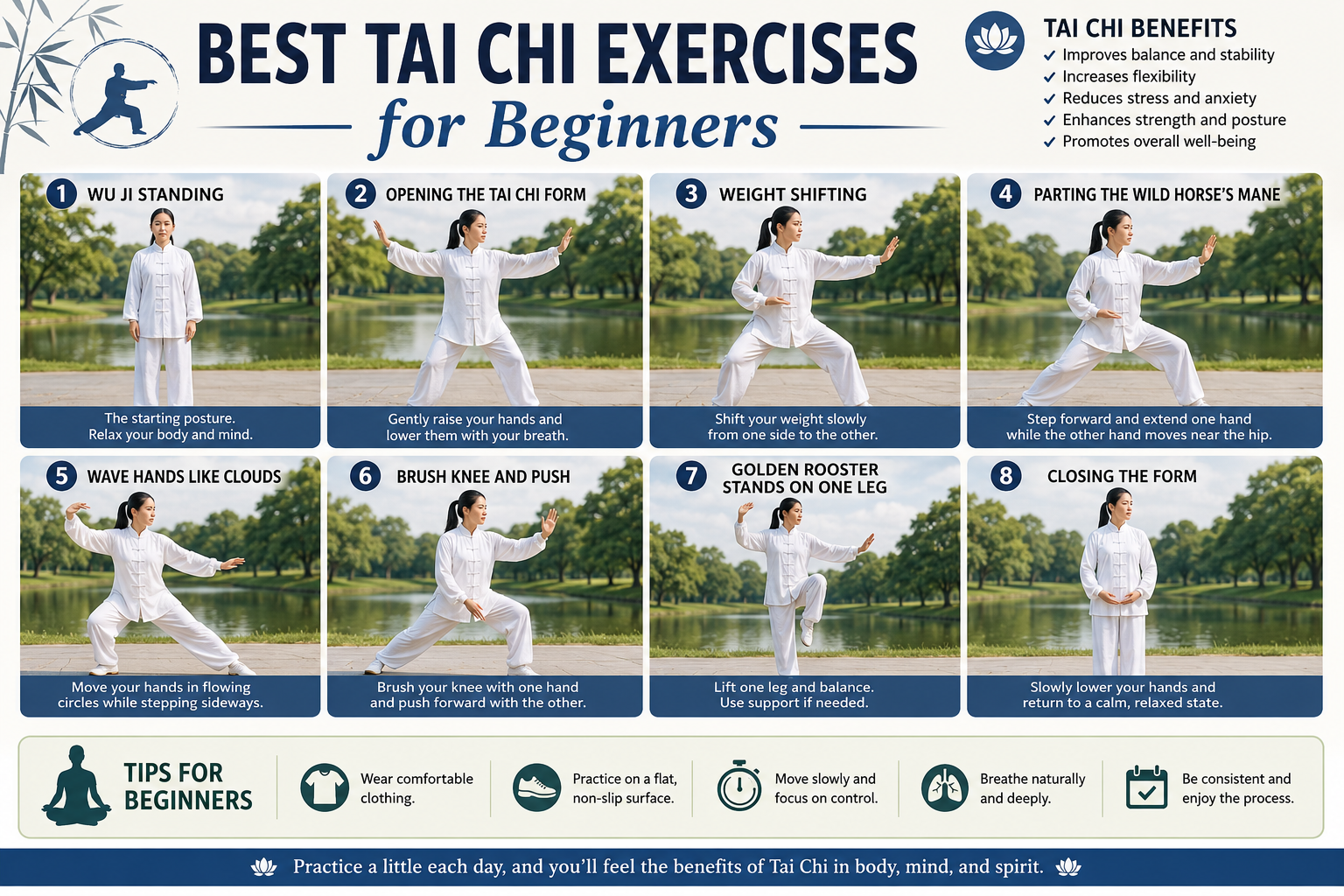
1. Wu Ji Standing (Neutral Stance)
Every tai chi session begins with proper posture.
Stand with your feet shoulder-width apart and let your arms relax naturally at your sides. Keep your knees slightly bent while lengthening your spine. Relax your shoulders and breathe slowly through your nose.
This simple position teaches body alignment, improves posture, and prepares both the body and mind for movement.
Practice for 2 to 5 minutes before beginning other exercises.
2. Opening the Tai Chi Form
The opening movement introduces controlled motion and breathing.
Begin in the neutral stance. Slowly raise both hands to shoulder height while inhaling. Gently lower them back down as you exhale.
Move slowly without locking your elbows or lifting your shoulders.
Benefits include:
- Relaxed breathing
- Improved coordination
- Better concentration
- Increased body awareness
Repeat 8 to 10 times.
3. Weight Shifting Exercise
Learning to transfer body weight smoothly is essential in tai chi.
Stand comfortably with your feet apart. Shift your weight slowly onto your left foot while keeping your upper body relaxed. Pause briefly before shifting to the right.
Avoid sudden movements and keep your breathing steady.
This exercise helps improve:
- Balance
- Stability
- Leg strength
- Joint mobility
Practice for 3 to 5 minutes.
4. Parting the Wild Horse’s Mane
This classic beginner movement teaches coordination between the upper and lower body.
Step forward gently while one hand extends outward as if offering an object. The opposite hand moves downward near the hip. Alternate sides with smooth, flowing motions.
This exercise develops:
- Full-body coordination
- Leg strength
- Smooth weight transfer
- Better posture
5. Wave Hands Like Clouds
One of the most recognizable tai chi exercises, this movement emphasizes flowing motion.
Stand with knees slightly bent. Move sideways while your hands glide across your body in circular motions. Your eyes follow your leading hand as you breathe naturally.
Benefits include:
- Improved coordination
- Increased flexibility
- Better rhythm
- Reduced muscle tension
Practice slowly until each movement feels natural.
6. Brush Knee and Push
This exercise combines stepping, turning, and arm movements into one smooth sequence.
Step forward while one hand brushes past your knee and the opposite palm gently pushes forward.
This movement helps improve:
- Core stability
- Balance
- Coordination
- Functional strength
Focus on moving from your hips rather than using only your arms.
7. Golden Rooster Stands on One Leg
Although slightly more challenging, beginners can practice a modified version.
Shift your weight onto one foot while lifting the opposite knee a few inches off the ground. Raise the opposite hand naturally for balance.
Use a chair or wall for support if necessary.
Benefits include:
- Better balance
- Stronger ankles
- Improved coordination
- Increased confidence
Hold each side for several seconds before switching.
8. Closing the Form
Finish every practice by slowing your breathing.
Stand quietly with your feet shoulder-width apart. Slowly lower your hands while taking deep, relaxed breaths.
Spend one or two minutes simply standing and allowing your heart rate to return to normal.
This ending reinforces relaxation and mindfulness.
Tips for Practicing Tai Chi as a Beginner
To get the most from your practice:
- Wear comfortable clothing that allows free movement.
- Practice on a flat, non-slip surface.
- Move slowly rather than trying to memorize every position.
- Focus on smooth breathing throughout each exercise.
- Practice consistently, even if only for 15 minutes each day.
- Avoid forcing your joints beyond a comfortable range of motion.
- Be patient as balance and coordination improve gradually.
Common Beginner Mistakes
Many new practitioners make similar mistakes when learning tai chi.
Avoid:
- Moving too quickly
- Holding your breath
- Locking your knees
- Raising your shoulders
- Looking down continuously
- Trying to perfect every movement immediately
Tai chi emphasizes steady progress rather than perfection.
Creating a Simple Beginner Routine
A basic 20-minute routine might include:
- Wu Ji Standing – 3 minutes
- Opening the Form – 3 minutes
- Weight Shifting – 4 minutes
- Parting the Wild Horse’s Mane – 4 minutes
- Wave Hands Like Clouds – 3 minutes
- Closing the Form – 3 minutes
Practicing this routine several times each week helps build confidence while developing the fundamental skills needed for more advanced forms.
Final Thoughts
The best tai chi exercises for beginners focus on slow, controlled movements that develop balance, flexibility, strength, and mindfulness. You don’t need previous experience or exceptional fitness to begin. By practicing consistently and paying attention to posture, breathing, and smooth movement, you can enjoy the many physical and mental benefits that tai chi offers.
Start with the basic exercises outlined in this guide, progress at your own pace, and remember that every practice session is an opportunity to improve your health, reduce stress, and build lasting confidence.